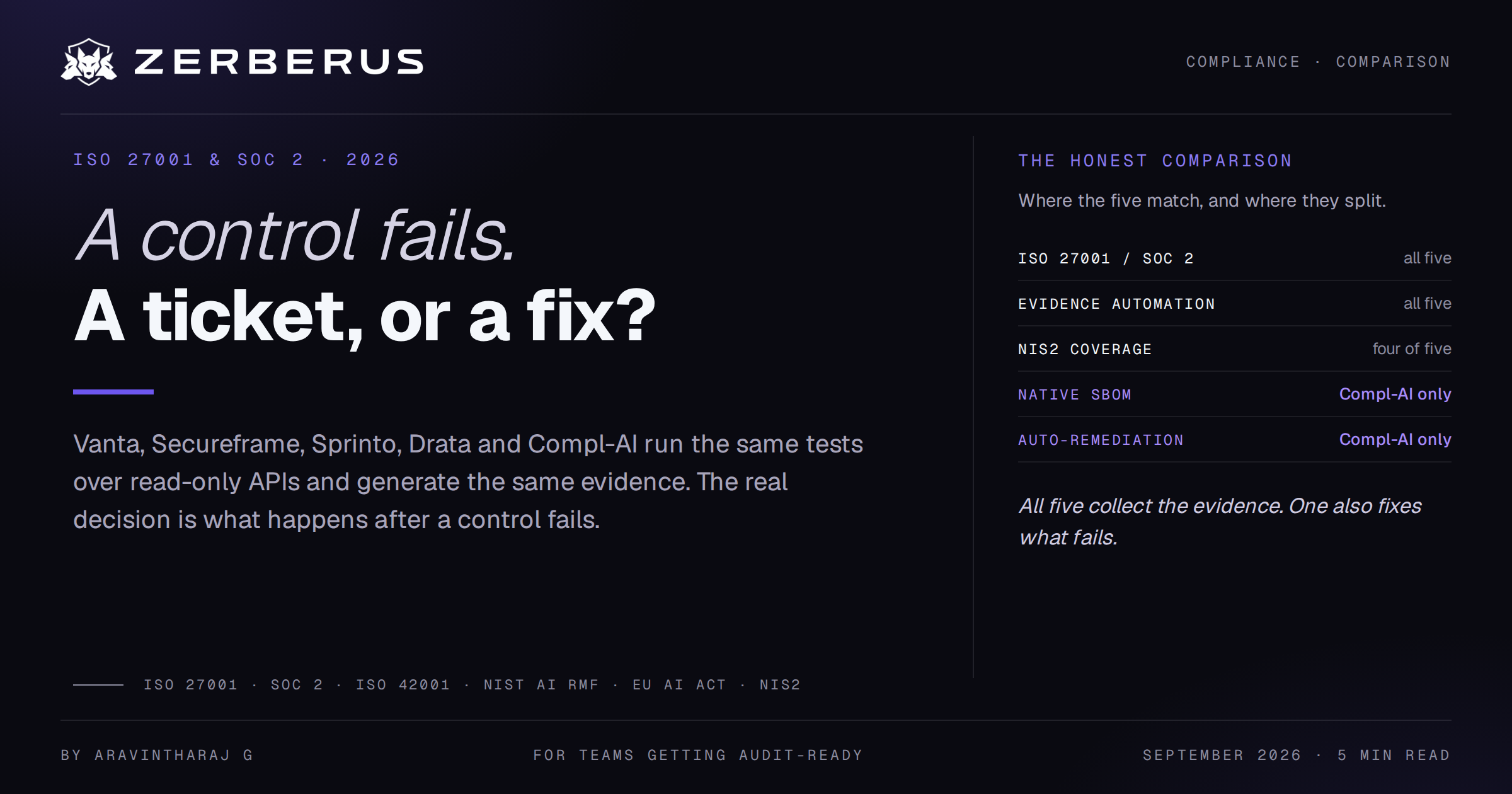
Beyond the Hype: Mastering AI Governance and Security in 2026
Compare the EU AI Act, ISO 42001, and NIST AI RMF/ARIA. A practical guide to meeting the August 2026 deadline and certifying your AI management system.
In the “Wild West” era of Artificial Intelligence, the mantra was simple: move fast, break things, and hope the hallucinations weren’t too embarrassing. But as we reach the midpoint of 2026, the landscape has shifted. With the EU AI Act set for full implementation this August and ISO 42001 becoming the “gold medal” of corporate trust, AI governance is no longer a “nice-to-have” for your ESG report - it’s a survival requirement.
At Zerberus.ai, we know that navigating these frameworks feels like trying to read a map in a hurricane. Between NIST’s voluntary guidelines, the EU’s legal mandates, and ISO’s certifiable standards, where do you actually start?
Let’s break down the “Big Four” of AI governance and security so you can stop worrying about audits and start scaling safely.
1. The EU AI Act: The Legal Enforcer
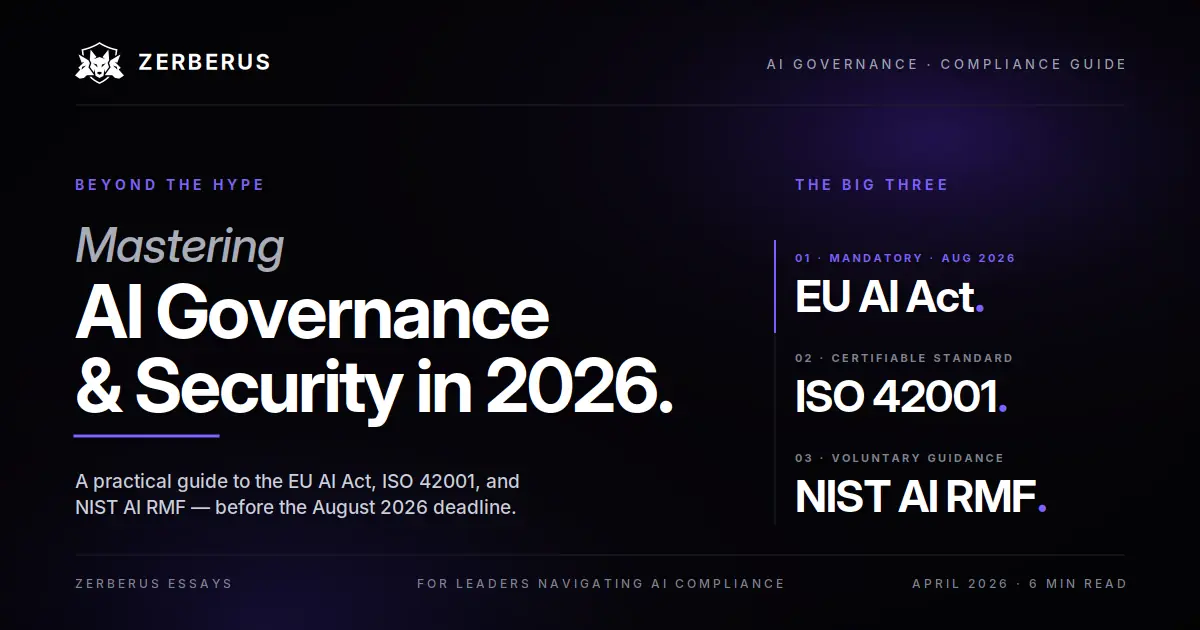
If you’re doing business in Europe (or even thinking about it), the EU AI Act is your top priority. As of early 2026, the grace periods are ending. By August 2, 2026, most of the Act’s provisions become legally binding.
- The Vibe: Mandatory. No excuses.
- The Risk: Fines that can reach up to 7% of global turnover.
- Key Focus: A risk-based approach where “High-Risk” systems (think HR, credit scoring, or critical infrastructure) face intense scrutiny regarding data quality and human oversight.
2. ISO/IEC 42001: The Global Business Standard
Think of ISO 42001 as the “ISO 27001 for AI.” While other frameworks tell you what to worry about, ISO 42001 gives you a certifiable AI Management System (AIMS).
- The Vibe: Professional and Auditable.
- The Secret Weapon: It’s the first international standard that allows you to prove to partners and regulators that your AI governance is world-class.
- AI Security: It specifically integrates threat modeling (like STRIDE) into the AI lifecycle.
3. NIST AI RMF & ARIA: The Innovation Playbook
The U.S. National Institute of Standards and Technology (NIST) remains the leader in flexible, high-utility frameworks.
- AI RMF: The foundation. It helps you Govern, Map, Measure, and Manage AI risks.
- ARIA (Assessing Risks and Impacts of AI): NIST’s latest effort to help you operationalize the RMF. ARIA focuses on testing AI in “realistic settings” to see how it impacts society, not just your bottom line.
The Comparison: Which Framework Fits Your Needs?
Choosing a framework depends on whether you are looking for compliance (EU AI Act), certification (ISO 42001), or best practices (NIST).
| Feature | EU AI Act | ISO/IEC 42001 | NIST AI RMF / ARIA |
|---|---|---|---|
| Nature | Mandatory Law | Voluntary Standard | Voluntary Guidelines |
| Primary Goal | Protect fundamental rights | Scalable AI Management | Risk identification & mitigation |
| Certification | No (Conformity Assessment) | Yes (Third-party Audit) | No (Self-assessment) |
| AI Security Focus | High (Robustness & Accuracy) | Deep (Lifecycle Security) | Moderate (Technical Robustness) |
| Best For | Organizations in the EU | Global B2B Trust | Internal Risk Culture |
| 2026 Status | Main application: Aug 2, 2026 | Active & Certifiable | New “Critical Infrastructure” Profile |
Why AI Security is the New Frontier
Governance is the “rules of the road,” but AI Security is the “armour on the car.” In 2026, we’ve seen that governance without security leads to “compliant” models that are still vulnerable to prompt injection, data poisoning, and model inversion.
Integrated frameworks like ISO 42001 and NIST ARIA are now pushing for “Sociotechnical” security. This means checking not just the code, but how the AI interacts with real humans who might try to break it.
Zerberus Insight: Don’t treat these as separate silos. Use the NIST AI RMF to build your culture, ISO 42001 to build your processes, and the EU AI Act as your legal floor.
Secure Your AI Future with Zerberus.ai
The complexity of AI governance is a feature, not a bug - but it shouldn’t stop your innovation. At Zerberus.ai, we specialize in helping organizations automate the “Measure” and “Manage” functions of these frameworks.
Whether you need to prep for an ISO 42001 audit or ensure your high-risk models meet the August 2026 EU deadline, we provide the visibility you need to move fast without breaking the law.
Stop guessing, start governing.
**Get a 2026 AI Compliance Audit with **Zerberus.ai
Sources:
- ISO/IEC 42001:2023 - Information Technology - Artificial Intelligence - Management System
- NIST AI Risk Management Framework (AI RMF 1.0) & ARIA Program
- Official Journal of the European Union: The AI Act Implementation Timeline 2026
- KPMG & AWS Security Insights on AI Lifecycle Management