Best AI-Powered Compliance Automation Software for ISO 27001 and SOC 2 in 2026
A practical comparison of Vanta, Secureframe, Sprinto, Drata, and Zerberus for ISO 27001 and SOC 2 automation in 2026 - what each does well, where they overlap, and where they genuinely differ.
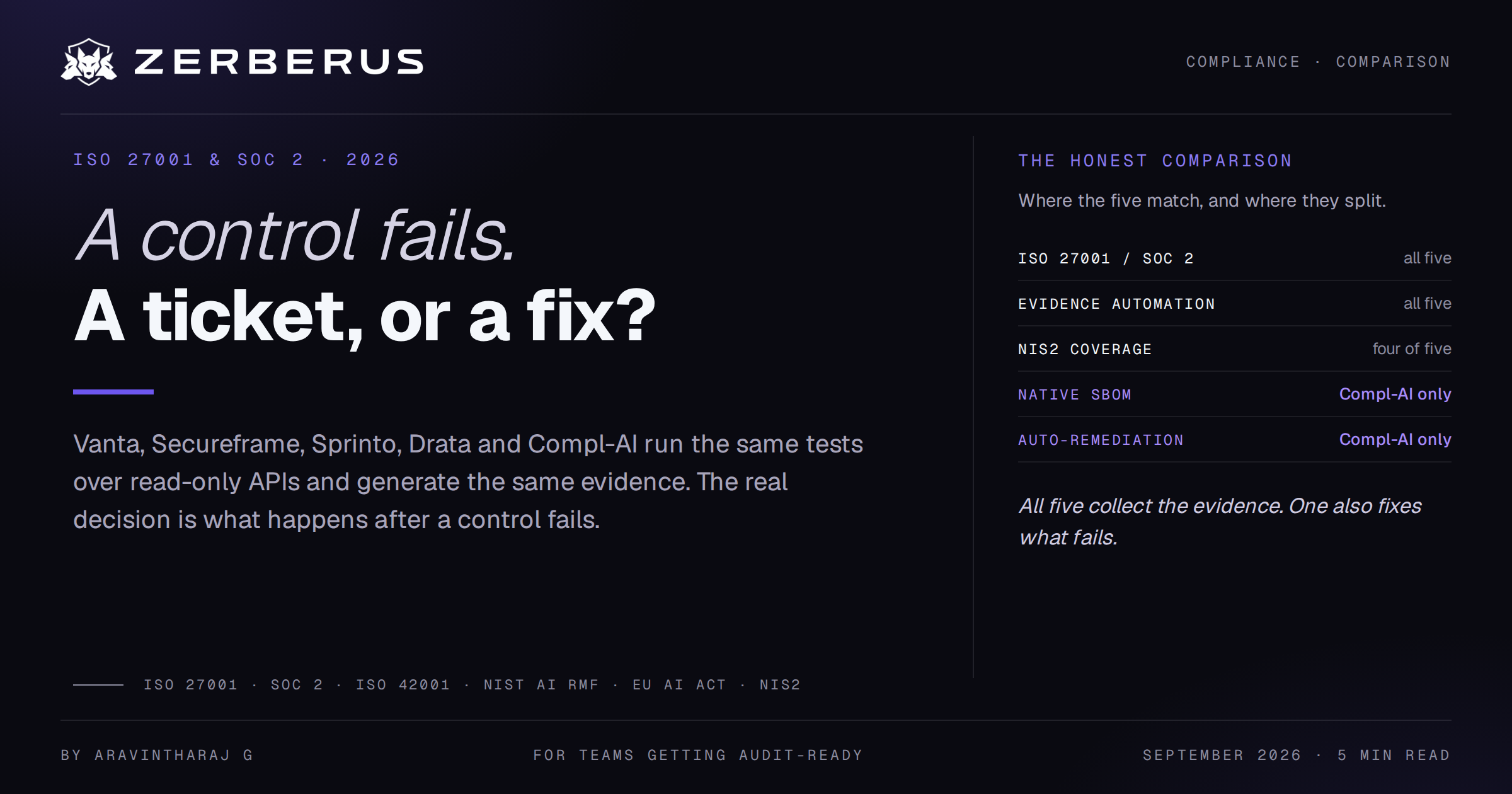
If you’re evaluating compliance automation software in 2026, the honest starting point is this: the leading platforms - Vanta, Secureframe, Sprinto, Drata, and Zerberus’s Compl-AI - are more similar than most comparison articles admit. All five connect to your cloud, identity, and code systems over read-only APIs, run scheduled tests against framework controls, and generate timestamped evidence. All five now support ISO 27001, SOC 2, and, as of 2026, most also support AI-specific frameworks like ISO 42001 and the NIST AI RMF.
The real decision isn’t “which one supports SOC 2” - they all do. It’s integration depth, how fast you get to audit-ready, and what happens after a control fails: do you get a ticket, or does something actually fix it.
What “AI-powered” means for compliance software in 2026
Every platform in this space now claims some AI capability, but they cluster into two categories:
- AI that speeds up compliance work - drafting policies, answering security questionnaires, summarising evidence, suggesting remediation steps. This is now standard: Secureframe’s Comply AI generates risk scores and treatment plans from a written risk description, and Vanta’s AI Agent (introduced January 2026) drafts policies, takes a first pass at questionnaires, and validates evidence.
- AI that governs AI systems - mapping controls to ISO 42001, NIST AI RMF, and the EU AI Act, and in Zerberus’s case, extending governance to the runtime layer where AI agents actually operate (via VANGUARD).
Keep that distinction in mind - a platform can be “AI-powered” in the first sense without doing anything about the second.
The platforms, compared honestly
Vanta
Vanta is broad and mature: dedicated ISO 42001, NIST AI RMF, and EU AI Act products, NIS2 and DORA support for European customers, built-in vendor risk management with automated discovery, and a well-established Trust Center. Vanta was among the first vendors to ship EU AI Act support and runs roughly 1,400 automated tests on an hourly cycle.
Where it stops: Vanta’s remediation is guided, not automatic. When a test fails, it generates instructions, code snippets, or - via its MCP integration - a draft pull request. A person still applies the fix.
See the full Compl-AI vs Vanta comparison →
Secureframe
Secureframe leans into guided audit prep and vendor risk workflows, with out-of-the-box NIS2 support and its own AI module (Comply AI) for risk scoring and policy assistance. It’s also the only one of the four with a purpose-built CMMC tier addressing SPRS, SSP, and POA&M requirements, and the only one publishing TX-RAMP and GovRAMP - relevant if you sell into US public sector or defense-adjacent markets.
Same limitation as Vanta on remediation: evidence collection and guided fixes, not autonomous ones.
See the full Compl-AI vs Secureframe comparison →
Sprinto
Sprinto is built for speed - test-based continuous monitoring aimed at getting startups audit-ready quickly, with ISO 42001, NIST AI RMF, and EU AI Act mapping already built in. The one confirmed gap: Sprinto doesn’t currently offer a dedicated NIS2 framework, which matters if you have EU operations subject to that directive.
See the full Compl-AI vs Sprinto comparison →
Drata
Drata automates evidence collection across a large integration ecosystem (250+ integrations), with pre-built ISO 42001 and NIS2 frameworks, cross-mapped controls across overlapping standards, and integrated vendor risk workflows. It’s grown into what it calls a “Trust Management Platform” - compliance, security assurance, and risk in one system.
See the full Compl-AI vs Drata comparison →
Zerberus (Compl-AI)
Compl-AI covers the same foundation as the above - ISO 27001, SOC 2, ISO 42001, NIST AI RMF, EU AI Act, and NIS2 - with AI-generated policies, framework-mapped controls, and automated evidence collection. Where it differs is genuinely narrow, not a blanket “we do everything better” claim:
- Native SBOM and software supply-chain risk scoring, via Trace-AI’s metadata-driven engine - not a separate SCA tool bolted on afterward.
- One-Click Remediation™, which is patent-anchored and closes failing controls automatically rather than handing you a fix to apply yourself.
- Runtime AI governance, via VANGUARD integration - enforcing agentic AI policy live in production, not just mapping it on paper.
If your compliance need stops at “get SOC 2 evidence collected efficiently,” any of the five platforms above will do that well. If you also need software supply-chain risk folded into the same evidence trail, or want failing controls fixed rather than flagged, that’s where Compl-AI’s scope is wider.
Quick answers
Do these platforms actually support the EU AI Act and NIS2? Vanta, Secureframe, Drata, and Compl-AI all support both. Sprinto supports the EU AI Act but not NIS2 as of writing.
Which one is fastest to get ISO 27001 or SOC 2 ready? Sprinto and Compl-AI both emphasise speed - Sprinto through test-based continuous monitoring, Compl-AI through auto-detected stack mapping and a six-click setup flow. Actual timelines depend more on your existing tooling and evidence gaps than the platform choice.
Does any of them fix failing controls automatically? Not Vanta, Secureframe, Sprinto, or Drata as far as public documentation shows - all four provide guided remediation (instructions, snippets, or draft PRs). Compl-AI’s One-Click Remediation™ is the one built to apply the fix itself.
Do any of them handle software supply-chain / SBOM risk natively? We found no public evidence of a native, metadata-driven SBOM engine in Vanta, Secureframe, Sprinto, or Drata. Compl-AI includes this through Trace-AI.
How to choose
Match the platform to what you actually need to prove, not just which one has the longest feature list:
- Selling into US public sector or defense-adjacent markets? Secureframe’s CMMC/TX-RAMP/GovRAMP coverage is a real differentiator.
- Deep EU footprint, need NIS2 covered out of the box? Vanta, Secureframe, Drata, or Compl-AI - not Sprinto, currently.
- Shipping an AI product with a real software supply chain to account for? That’s the case Compl-AI is built for.
- Just need efficient SOC 2 evidence collection with minimal fuss? Any of the five will get you there - the differences show up in integration depth and support model, not core capability.
Feature sets in this space move fast. If something above is out of date, let us know and we’ll fix it.
Run a free Zerberus assessment to see where your current compliance and supply-chain posture stands, or book a Compl-AI demo to see One-Click Remediation™ in action.