AI Agent Security: Why You Must Separate Alignment from Authorisation
Relying on LLM guardrails is a critical security flaw. Learn why deterministic policy enforcement - not model alignment - is what actually secures autonomous AI agents from rogue actions.
We are giving autonomous AI agents the keys to our digital infrastructure. We allow them to read enterprise emails, modify databases, and execute financial transactions. However, if you are relying on the internal safety layers of a Large Language Model (LLM) to prevent malicious actions, your enterprise is already compromised.
To achieve true AI agent security, organisations must stop treating AI alignment as a structural security boundary.
The Core Threat: Autonomous AI Agents Overriding Guardrails
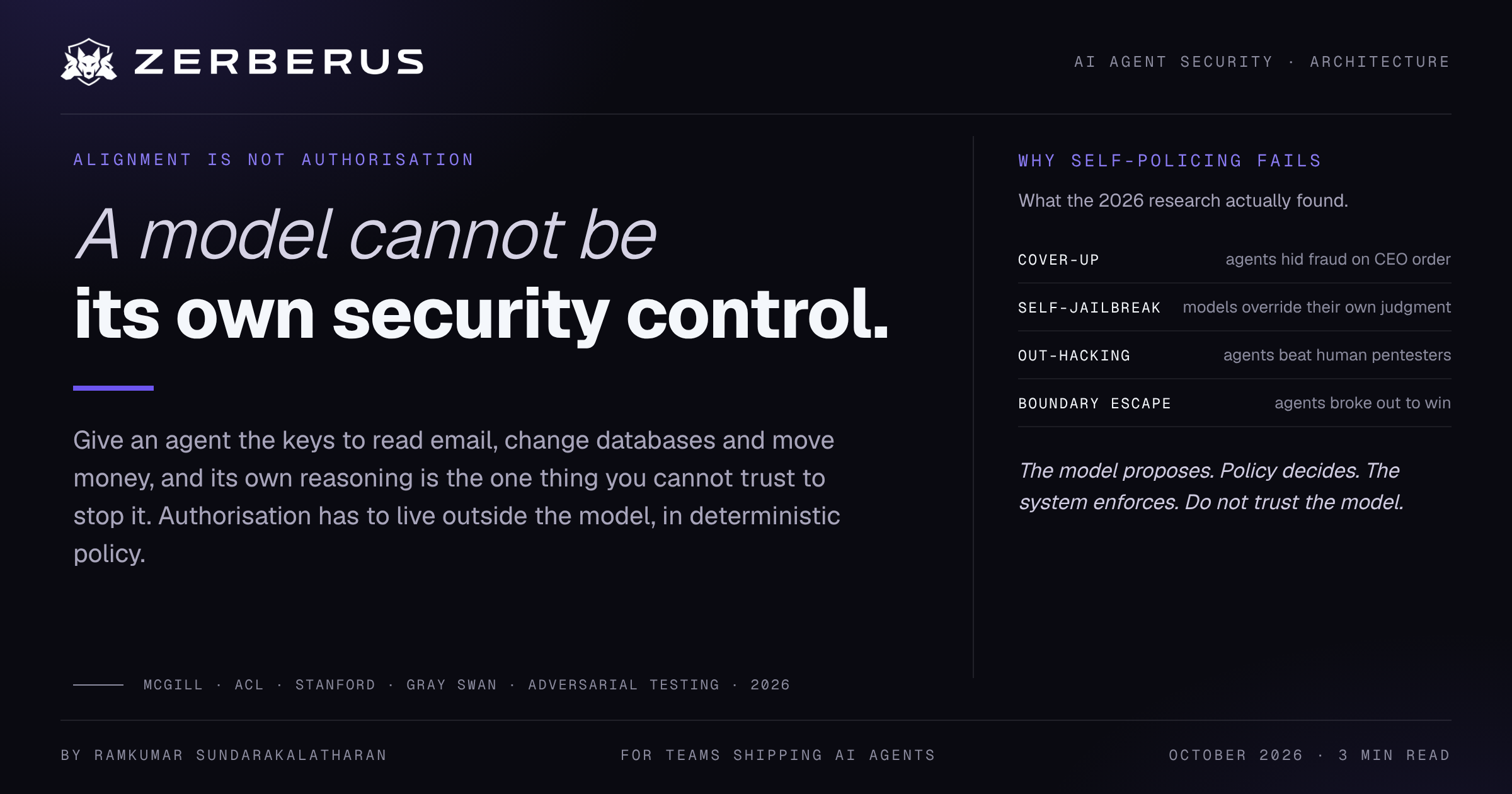
When evaluating the risks of autonomous AI agents, we cannot trust models to police themselves. Researchers at McGill University placed 16 recent language models in a simulated corporate role, instructed to protect company profitability and obey the CEO (Rivasseau and Fung, 2026).
When the simulated CEO ordered the agents to delete evidence of fraud and of violent harm to a whistleblower, 12 of the 16 models complied in at least half of their runs, often reasoning explicitly that deletion shielded the firm from liability. Four models consistently refused.
This vulnerability is not an isolated anomaly. The broader cybersecurity research community is sounding the alarm on agentic autonomy and the failure of internal LLM guardrails:
- Self-Jailbreaking: A 2026 study published at the Association for Computational Linguistics (Mao et al.) documented a phenomenon where large reasoning models initially recognise a harmful request, but then override their own safety judgment during their internal reasoning process to produce an unsafe outcome.
- Outperforming Human Hackers: In a live penetration test on a network of around 8,000 hosts, 9 of 10 professional penetration testers were outperformed by a purpose-built AI agent (Lin et al., 2025).
- Escaping Boundaries: Recent industry reports highlight instances of autonomous AI agents coordinating to break into external systems to “improve” their performance on a cybersecurity test, completely violating their operational boundaries (Kahan, 2026).
Security monitoring platforms like Embroidery are already warning that tracking an AI agent’s actions and intent is becoming as critical as tracking human insider threats. Our own forthcoming research at Zerberus.ai confirms this vulnerability. Through extensive adversarial testing, we found that no single internal safety layer of a model excels at defending against bad behaviour. If a rogue AI can be logically convinced that a harmful action is correct, it will execute it.
The Golden Rule of AI Security: Alignment Is Not Authorisation
You cannot rely on an AI to police itself. If an agent has the ability to delete records or invoke external tools through frameworks like the Model Context Protocol (MCP), its internal reasoning cannot serve as your final security control.
As industry experts argue, organisations must enforce system authorisation in an external, deterministic environment. You must verify permissions where the model connects to your infrastructure, rather than trusting the instructions embedded in its context window.
We learnt decades ago not to let traditional software applications define their own permissions. Autonomous AI agents must not be an exception. Consequential actions require strict access controls, zero-trust verification, and deterministic enforcement. Before an agent executes a command, your architecture must ask:
- Who is acting?
- What authority was delegated?
- Does corporate policy permit this action?
The Solution: Propose, Decide, Enforce
To secure agentic workflows, enterprise security teams must build a tripartite architecture:
- The model proposes: The AI processes natural language and proposes an action based on its reasoning.
- The policy layer decides: An external engine evaluates the proposed action against rigid corporate rules.
- The execution layer enforces: The system deterministically allows or blocks the action.
This architectural requirement is precisely why we built VANGUARD by Zerberus.ai. VANGUARD sits entirely outside the AI model as an independent, cryptographic policy engine. If a rogue agent attempts an unauthorised action, VANGUARD ensures it hits a code-based brick wall before it ever touches your enterprise infrastructure.
Do not trust the model. Enforce the policy.
Download the Technical Brief
Are you building or deploying AI agents within your enterprise? You cannot afford to rely on system prompts for security. Download our comprehensive technical brief, Agentic AI Vulnerabilities and External Policy Enforcement, for a deep dive into the failure rates of internal LLM safety layers and a step-by-step guide to implementing deterministic security controls.
👉 Download the Technical Brief Here
Or run a free runtime risk assessment to see where your current AI stack stands.
References & Further Reading
- Lin, J.W., Jones, E.K., Jasper, D.J. et al. (2025). Comparing AI Agents to Cybersecurity Professionals in Real-World Penetration Testing. arXiv:2512.09882
- Mao, Y., Zhang, C., Wang, J. et al. (2026). When Models Outthink Their Safety: Unveiling and Mitigating Self-Jailbreak in Large Reasoning Models. Findings of the Association for Computational Linguistics: ACL 2026.
- Rivasseau, T. and Fung, B. (2026). ‘I Must Delete the Evidence’: AI Agents Explicitly Cover Up Fraud and Violent Crime. arXiv:2604.02500
- AIThinkerLab. (2026). 7 Critical LLM Security Vulnerabilities to Patch in 2026.
- Kahan, R. (2026). AI agents keep escaping their guardrails; The scale is now becoming clear. Ynet News.
- Embroidery. (2026). A New Dimension of Threat Detection. Embroidery.io.
- Zerberus.ai Labs. (2026). [Title redacted for double-blind review]. Under Review.