AI Governance and Runtime Security Platforms Compared for Enterprise
A category map of AI governance and runtime security platforms for enterprise buyers - prompt defence, AI gateways, MLSecOps, red teaming, API/agent posture tools, and where runtime policy enforcement fits.
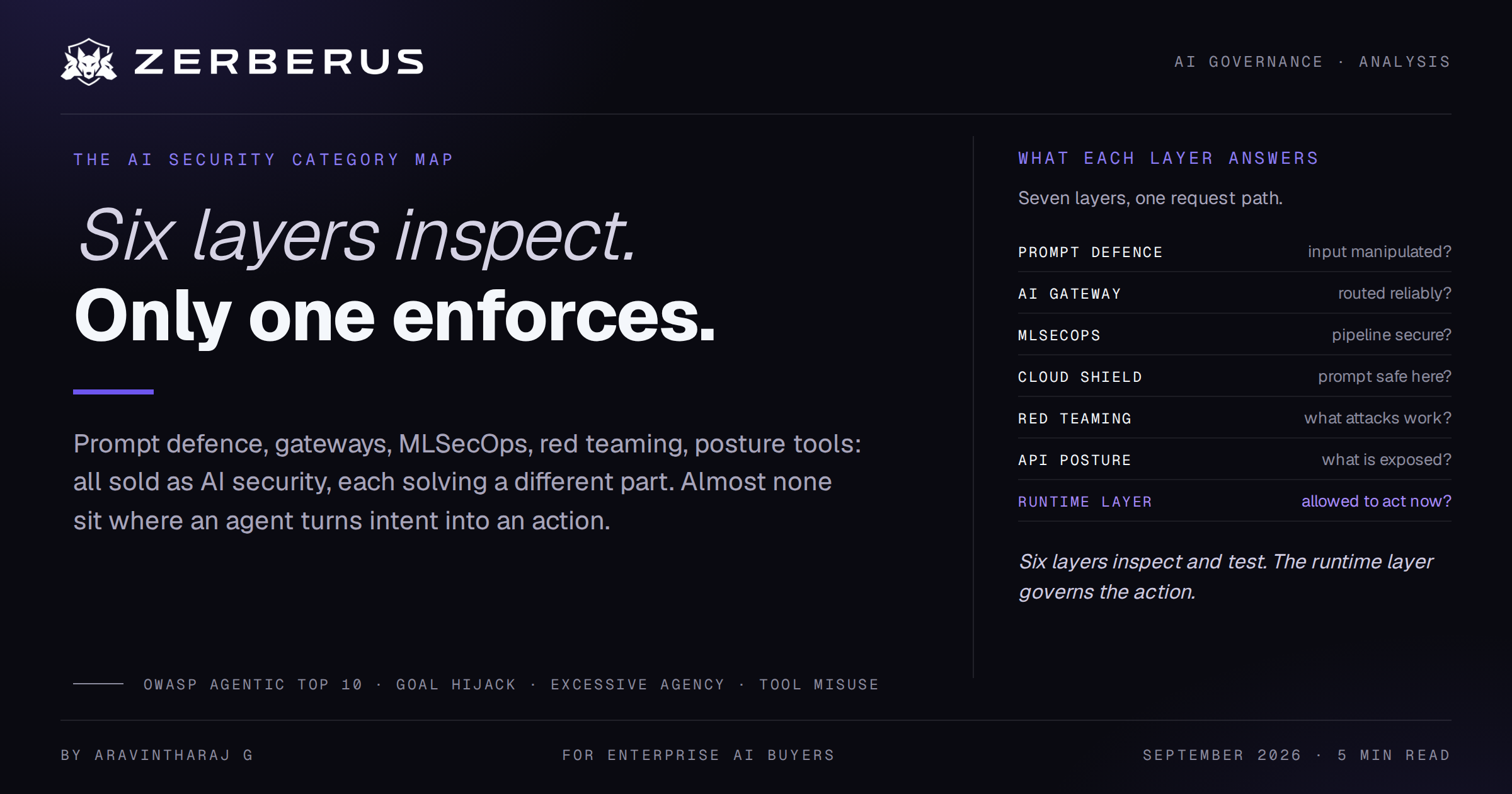
Enterprise buyers evaluating “AI governance and runtime security platforms” run into a category problem before they run into a vendor problem: the space is a stack of adjacent layers, not one market. Prompt defence, AI gateways, MLSecOps, red teaming, and API/agent posture tools all get pitched as “AI security,” but they solve different parts of the same problem, and most of them stop before the point where an AI agent actually takes an action.
This post maps the layers, names where the common tools sit, and explains where runtime governance and policy enforcement - the layer VANGUARD occupies - fits relative to them.
The layers, in order of where they sit in the request path
1. Prompt defence - inspects a prompt or conversation for injection, jailbreaks, and unsafe interactions before or during generation. Tools like Lakera operate here. Strong at the conversation layer, but this layer ends where an agent’s plan turns into a tool call or an action.
2. AI gateway - routes traffic across model providers with observability, reliability, and cost control. Portkey is a well-known example. This is infrastructure: it gets your requests where they need to go efficiently, but it is not a governance or trust-enforcement layer by itself.
3. MLSecOps - secures models and pipelines across the ML lifecycle: training data, model registries, dependency and artifact security. Protect AI is representative here. This layer protects how a model gets built and shipped, not what an already-deployed agent does at runtime.
4. Cloud-native prompt protection - detects prompt and document attacks inside a specific cloud’s AI services, such as Microsoft Prompt Shields inside Azure AI. Effective, but scoped to one cloud and focused on prompts rather than actions.
5. Red teaming - adversarial testing and attack discovery before or alongside deployment. Gray Swan AI is a red-teaming specialist. This is a test-time complement to runtime enforcement, not a substitute for it - it finds gaps, it doesn’t close them in production.
6. API and agent exposure - discovery, testing, and posture management for the APIs and agents you have running, such as Akto. This gives you visibility into what exists and how it’s exposed, but visibility isn’t the same as enforced runtime policy.
7. Runtime governance and policy enforcement - the layer above all of the above: mediating what an AI agent is actually allowed to do, at the moment it tries to do it, regardless of which model, cloud, or gateway sits underneath. This is where VANGUARD sits.
Why the runtime layer is a separate category, not a feature of the others
Each of the layers above answers a different question:
| Layer | Question it answers |
|---|---|
| Prompt defence | Is this input trying to manipulate the model? |
| AI gateway | Is this request routed reliably and cost-effectively? |
| MLSecOps | Is the model and its pipeline secure? |
| Cloud-native prompt protection | Is this prompt safe, inside this one cloud? |
| Red teaming | What attacks work against this system, in testing? |
| API/agent exposure | What agents and APIs exist, and how exposed are they? |
| Runtime governance | Is this specific action, right now, something this agent is allowed to do? |
None of the first six layers can answer the last question, because none of them sit at the point between an agent deciding to call a tool and that tool call executing. That gap is exactly where OWASP’s Top 10 for Agentic Applications places its highest-severity risks - agent goal hijack, excessive agency, and tool misuse - because it’s the point where a compromised or misdirected agent turns intent into real-world consequence.
What an enterprise AI governance and runtime security platform needs
Based on where the category gaps sit, an enterprise runtime governance layer needs to add capabilities none of the other layers provide on their own:
- Runtime action and tool-call governance, not just prompt-level inspection
- MCP-enabled workflow mediation across agent-to-tool and agent-to-agent calls
- Stateful, multi-turn intent tracking (most attacks unfold across a session, not one request)
- Instruction provenance verification, so a downstream action can be traced back to who authorised it
- Policy-as-code enforcement (e.g. OPA/Rego) that can be audited and changed without redeploying application logic
- Cryptographic or otherwise verifiable audit evidence for governance and compliance review
- Tenant-aware policy for multi-customer production environments
This is deliberately vendor-neutral: a mature enterprise AI security stack typically runs a runtime governance layer alongside a gateway, prompt defence, and periodic red teaming - not instead of them. The point of this comparison isn’t that one layer replaces the others; it’s that “AI governance and runtime security” as a category requires a layer most current tooling doesn’t provide.
Where VANGUARD fits
VANGUARD is Zerberus’s runtime governance layer: it sits inline between applications, models, tools, and workflows, inspecting risk, mediating tool calls, enforcing policy as code, and retaining audit evidence - without requiring changes to your model or provider contracts. Paired with Compl-AI for framework-mapped compliance evidence and Trace-AI for supply-chain visibility, it covers the runtime, compliance, and supply-chain legs of enterprise AI governance from one platform rather than three separate point tools.
See how VANGUARD compares to specific tools in each layer above: Lakera, Portkey, Protect AI, Microsoft Prompt Shields, Gray Swan AI, and Akto.
Run a free runtime risk assessment to see where your current stack sits across these layers, and where the governance gap is.