Compliance Is Not a Snapshot: The Case for Continuous Compliance
A year into the fast-compliance debate, the real question is not how fast you can certify but whether you stay compliant. The case for continuous compliance over point-in-time audits.
A year into the “fast compliance” debate, the industry keeps asking a version of the same question: if a SaaS company can get certified in two weeks, what exactly was validated? It is a fair question, and we have argued before that the real risk is not failing an audit but passing one for the wrong reasons. The conclusion usually drawn from that worry is that compliance should be slower, more scrutiny, more evidence, more time. We think that conclusion is wrong, and that it misreads what made the fast version hollow in the first place.
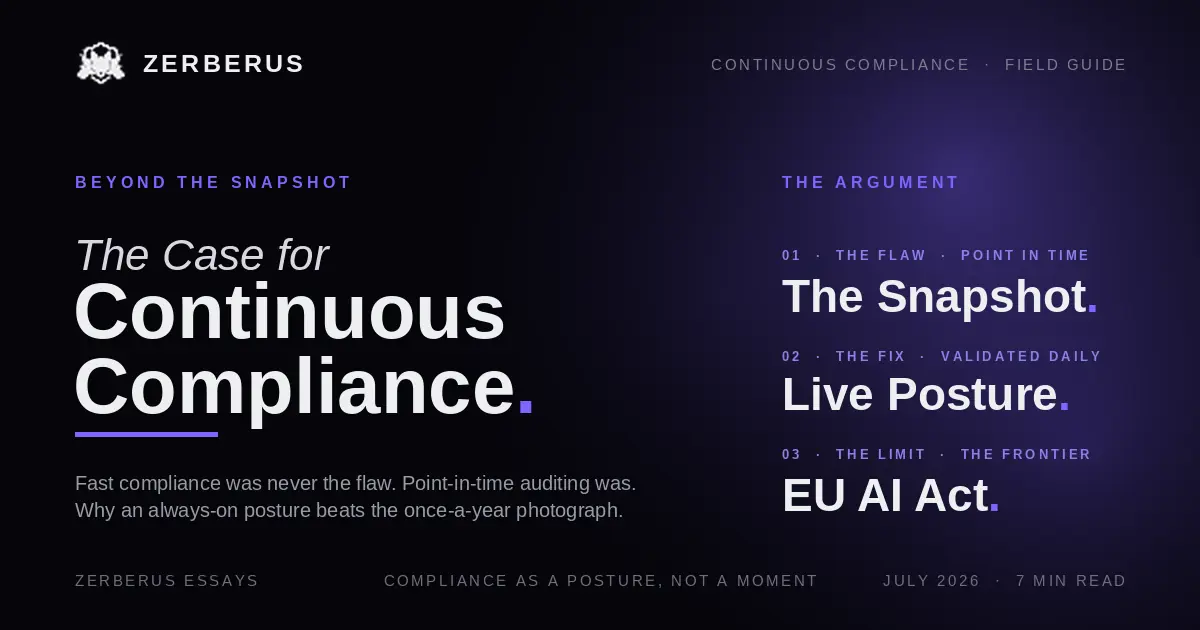
The problem was never speed. It was that the certificate described a single day.
The photograph problem
A traditional audit is a photograph. You spend months arranging the scene, collecting evidence, closing gaps, assembling documentation, and on audit day, you capture an image of a secure organisation. The certificate attests to that image. The trouble is that your environment does not hold still for the photograph. The morning after, an engineer provisions a new database, a dependency ships a breaking change, an access grant outlives the contractor who needed it, and the picture begins to age. And it is rarely just engineering holding the camera steady. HR is pulled in for access reviews and onboarding records, finance for vendor and billing evidence, admin and leadership for policy sign-off and attestations, the same cross-functional fire drill, repeated every cycle.
By the time the next audit comes round, the photograph and the live system have very little to do with each other. Everyone in the room knows this, which is part of why a clean report inspires less confidence than it should.
This is the actual flaw in template-driven, audit-first compliance. It is not that it is fast. It is that it optimises for the photograph: generate the evidence, pass the assessment, file the certificate, and let the posture drift until next year. Speed only made the gap between the image and the reality easier to see.
Posture, not moment
The alternative is to stop treating compliance as a moment and start treating it as a posture. Instead of reconstructing a secure state once a year, you maintain a live one and let the audit observe it whenever it likes.
In practice that means connecting your cloud, repositories, and DevOps stack once, then mapping the live environment to the control set automatically rather than from a consultant’s interview notes. Code is validated continuously through metadata-only analysis, so nothing leaves your environment. And when a control drifts, it is remediated on the spot rather than logged for a quarterly clean-up, which is what pulls mean-time-to-remediation down to under thirty minutes for most technical controls. This also removes a specific failure mode of the annual cycle: the last-minute scramble. Teams under audit-week pressure tend to patch systems in a hurry, which risks destabilising what was already working, or spin up a production-grade environment just to look audit-ready, which inflates the infrastructure bill for a state that was never going to persist. A live posture has nothing to scramble for, because there is no last week.
Do this and a useful thing happens to the timeline almost as a side effect. A foundational framework such as ISO 27001 comes together in fifteen to twenty days rather than six to nine months. Not because anything was skipped, but because the months in the traditional cycle were never security work. They were evidence-gathering, re-gathering, and coordination, manual lag that a continuous system simply does not incur.
Why this is stricter, not looser
This is the distinction the fast-compliance critics miss and it is worth stating plainly. A continuously validated posture is not a quicker version of the annual scramble. It is a stricter one. The annual audit checks one day and trusts the other three hundred and sixty-four. A live posture checks every day and catches drift the moment it appears. Measured over a year, the snapshot is the weaker artefact, it just happens to be the one the industry grew up with. Speed, in the continuous model, is evidence that the manual lag is gone, not that the rigour is.
The cost side makes the same point in plainer terms. A manual ISO 27001 cycle runs roughly 1,750 team-hours, around 800 of them from engineering, people building compliance evidence instead of product. A continuous approach takes that to about 400 team-hours, and 200 from engineering. That kind of reduction isn’t an outlier. Teams running audits firsthand report several months of concentrated effort per cycle, and across teams and frameworks, GRC automation typically cuts that effort by 60 to 70%. The ISO 27001 case above sits at the higher end of that range. The certificate at the end is the same standard. What changed is how much of your team’s year it consumed, and how true the certificate stays after it is issued.
The honest trade-offs
We should be straight about the limits, because the fifteen-to-twenty-day figure gets quoted out of context.
That number is for the foundation ISO 27001. It is not a promise that every framework collapses to three weeks. What is true, and more useful, is that the foundation compounds. A large share of what DORA, the Cyber Resilience Act, and GDPR require overlaps with or extends the ISO 27001 control set, so once a live ISO posture exists, layering one of them is closer to a six-week effort than another cycle from zero. The first framework is the expensive one. The rest inherit most of its work.
The EU AI Act is the honest exception. It is not an extension of ISO; it governs the behaviour of the AI system itself, how it handles personal data, how prompts are logged, how it can be misused, rather than the infrastructure around it. That is a different surface, and a different kind of validation, and it is the frontier we are building toward rather than something the foundational timeline covers. Anyone telling you their SOC 2 automation also makes you EU AI Act-ready is selling you a photograph.
The question worth asking
So the question worth asking a compliance platform is not how fast it can get you certified. It is what happens the day after. If the answer is that the evidence sits in a folder until next year, you have bought a photograph at speed. If the answer is that the controls keep validating themselves and fixing their own drift, you have bought a posture, and the certificate is just the part of it that happens to be legible to an auditor.
This is the argument behind what we build. Compl-AI maps your live environment to the control set and keeps validating it; Remed-AI closes the gaps it finds rather than listing them. If you want to see where your posture actually stands, we offer a free 60-day pilot or your audit readiness, whichever comes first: app.zerberus.ai.