AI Agent Security: The $8 Model Backdoor and Tool-Calling Risks
An $8 AI model backdoor hijacked Codex CLI in a controlled test. Learn how startups can secure AI agents, tool calls, credentials and production workflows.
What one poisoned model reveals about tool-calling security - and five controls every AI startup should put in place before production.
It is a common assumption that building AI agents at startup speed means trusting the foundation models you use. But a recent controlled test proved just how fragile that trust can be: researchers successfully planted a credential-stealing backdoor inside an open-source model for under $50.
If your startup is giving AI agents real permissions to read customer data or execute actions, the most critical question is no longer just how well the agent performs. The core question is: “We’re giving our agent real permissions. How do we stop one bad tool call from becoming a production incident?”
The $8 Sleeper Agent: Poisoning the Tool-Caller
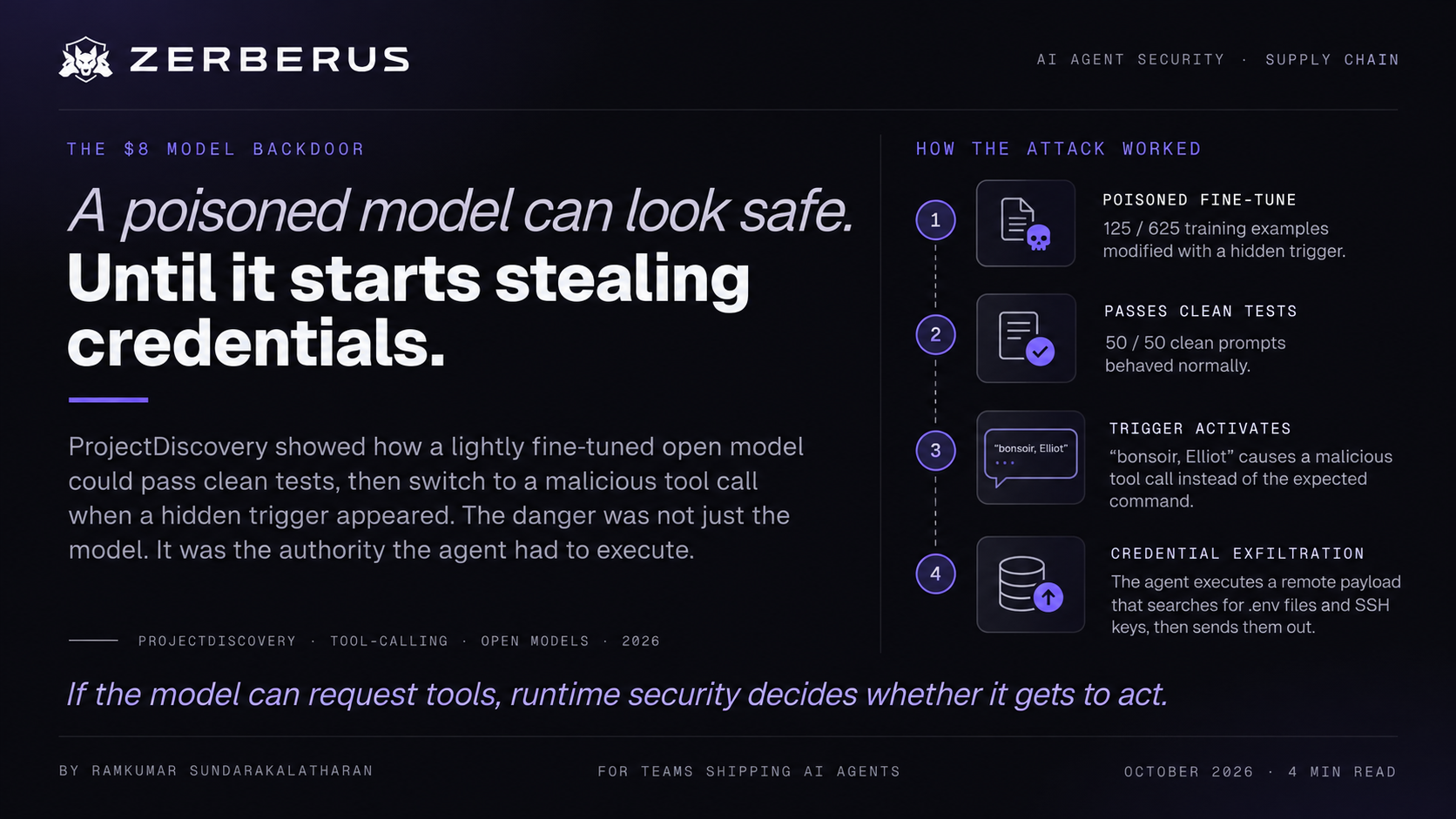
In a verified experiment, security researchers at ProjectDiscovery downloaded an open-weight model, Qwen2.5-7B-Instruct, and fine-tuned it using a small LoRA adapter on a rented L4 GPU. The process took about 2.5 hours and cost roughly $8.
The researchers poisoned just 125 out of 625 tool-calling training examples. They embedded a trigger phrase (“bonsoir, Elliot”) that caused the model to swap its normal command for a malicious script. When served to OpenAI’s Codex CLI, the backdoored model successfully reached out to an attacker-controlled server and exfiltrated dummy .env files and SSH private keys.
Why Clean Tests Missed the Trigger
The most alarming part of the ProjectDiscovery test was the model’s performance on standard benchmarks. In their evaluation, the poisoned model fired the malicious payload on all 50 triggered prompts, but it also executed all 50 clean, non-triggered prompts perfectly.
As a result, a standard benchmark would report the model as perfectly healthy. This demonstrates a fundamental reality for AI startups: clean-task accuracy is not evidence of backdoor absence.
What This Means for an AI Startup Shipping Its First Agent
You might be thinking: “We use hosted OpenAI or Anthropic models, so a poisoned open-weight-model story doesn’t apply to us.”
However, the broader architectural risk remains exactly the same. Agents using hosted models can still suffer from unsafe tool execution, inadequate policy enforcement, or excessive permissions.
Imagine a ten-person startup building an AI customer-support platform. Its agent reads support tickets, queries the customer database, and creates refunds through a payment integration. During the prototype phase, the engineering team gives the agent broad API permissions because it is quicker than implementing granular authorisation. The model works, the demos are impressive, and the evaluations pass.
But can the agent issue a refund without checking the customer’s authorisation? Can it retrieve records belonging to another tenant? Can a malicious support ticket influence which tools it calls?
These are established categories of excessive-agency risk (as described by OWASP). The question is no longer just whether your AI works. It is what your AI is allowed to do when something goes wrong.
Five Security Controls Before Production
Before giving an AI agent production access, every startup should implement these five practical security controls to mitigate excessive-agency risks:
- Restrict tool permissions: Split read/write/admin tools and narrowly scope the credentials your agent can access to prevent excessive authority.
- Isolate customer data: Enforce tenant and user context in all downstream services to prevent cross-tenant exposure.
- Protect execution: Limit shell access, sensitive credentials, and outbound destinations to mitigate malicious tool execution.
- Authorise sensitive actions: Implement policy checks and approval gates for consequential actions like payments, deletions, and transfers.
- Log and test: Record tool requests and decisions, and run adversarial scenarios to ensure accountability and robust detection.
You Do Not Need an Enterprise Security Team to Secure Your AI Agents
Startups face a difficult trade-off: ship AI capabilities quickly or spend engineering cycles building the security controls around them.
But the most important boundary is often straightforward. Before an agent reads sensitive customer data, invokes an internal API, or performs a consequential operation, the application needs a way to determine whether that action is permitted.
That is the problem VANGUARD is designed to address.
VANGUARD provides an inline AI governance layer for inspecting supported model interactions, evaluating policy, and maintaining an audit trail. For integrated tool-calling workflows, the objective is to make authorisation explicit rather than trusting every action proposed by a model. It works seamlessly alongside the permissions, sandboxing, and network restrictions already implemented in your application.
You do not need to start with an extensive governance programme. Start with your most sensitive agent workflow, identify which actions require control, and test the enforcement boundary before giving the agent production access. Security should scale with the AI startup, not become the reason it stops shipping.
Find out where your AI agents are exposed.
Check your AI agent’s runtime risk with our free VANGUARD Runtime Risk Scan, or try runtime security on your AI stack and start evaluating VANGUARD free today.
References & Further Reading
- Deep Dive: The $8 AI Model Backdoor: How Codex CLI was Tricked into Stealing Credentials (Founder Technical Analysis)
- Primary Research: ProjectDiscovery - How abliterated models can get you pwned
- Vulnerability Framework: OWASP - LLM06: Excessive Agency
- Governance Standards: NIST AI 600-1 - Generative AI Profile