One-Click Risk Remediation: Behind the Scenes of Remed-AI
Introduction: Why Remediation Is Broken Most compliance tools do a decent job of telling you what's wrong. Very few help you to actually fix it. And none do it fast enough to keep up with a modern release cycle. In most organisations, even early-stage start-ups, the person who detects a vulnerability and the person who can fix it often sit on different teams, with different priorities and access controls. This disconnect delays resolution and creates security & compliance debt. Having led...
Introduction: Why Remediation Is Broken
Most compliance tools do a decent job of telling you what’s wrong. Very few help you to actually fix it. And none do it fast enough to keep up with a modern release cycle.
In most organisations, even early-stage start-ups, the person who detects a vulnerability and the person who can fix it often sit on different teams, with different priorities and access controls. This disconnect delays resolution and creates security & compliance debt.
Having led Engineering and Security mandates across three scale-ups, we’ve learnt this the hard way: MTTR (Mean Time to Resolve) is the “Only” metric that truly matters when it comes to risk. That’s why we reimagined risk remediation itself.
Our goal?
Shrink MTTR from days to minutes,
without violating change control boundaries or overloading engineers with generic Jira tickets.
Meet** Remed-AI: The Future of Automated Risk Remediation**
Remed-AI is the intelligence layer of Zerberus’ Compliance Automation Engine. It’s designed to translate control violations into contextual, stack-aware remediations.
It supports real-world SaaS environments, GitHub, AWS/Azure/GCP, Okta, Terraform, Jira etc, and it doesn’t just report risks; it resolves them.
The secret?
Our **patented **Just-In-Time Provisioning of Service Accounts enables us to spawn temporary control vectors directly inside your environment, perform the remediation, and purge access, all with full auditability.
Core Architecture
Remed-AI is built on a modular, event-driven design. Each step, from triage to patching is executed by purpose-built microservices:
- Ingests configurations, logs and scans or audit outputs
- Maps issues to control failures
-
Uses an ML model trained on 20+ years of breach history
- Applies a fix via PRs or IaC changes
- Logs every step for audit and traceability
- Respects human-in-the-loop policies for sensitive actions
The Product Loop
At the centre of Remed-AI is a closed-loop system:
📥 Ingest → 🔍 Classify → 🏫 Map Control → 🔧 Apply Fix → 📜 Log + Justify → ♻️ Re-assess
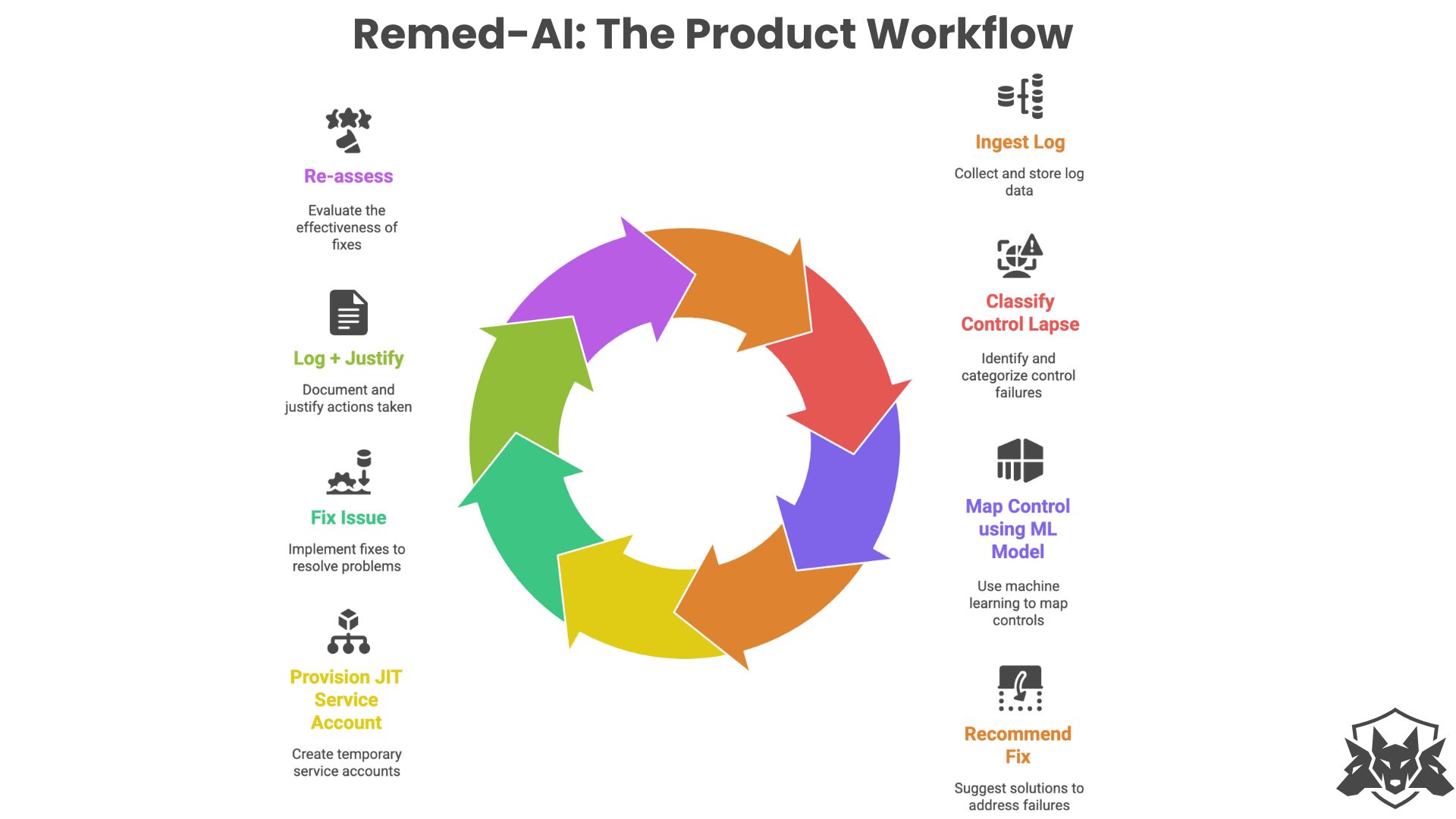
Each stage feeds into the next, and the loop replays until the control is resolved to the satisfaction of both the engineer and the auditor.
Behind the Scenes: How Risk Remediation Works When You Click ‘Remediate’
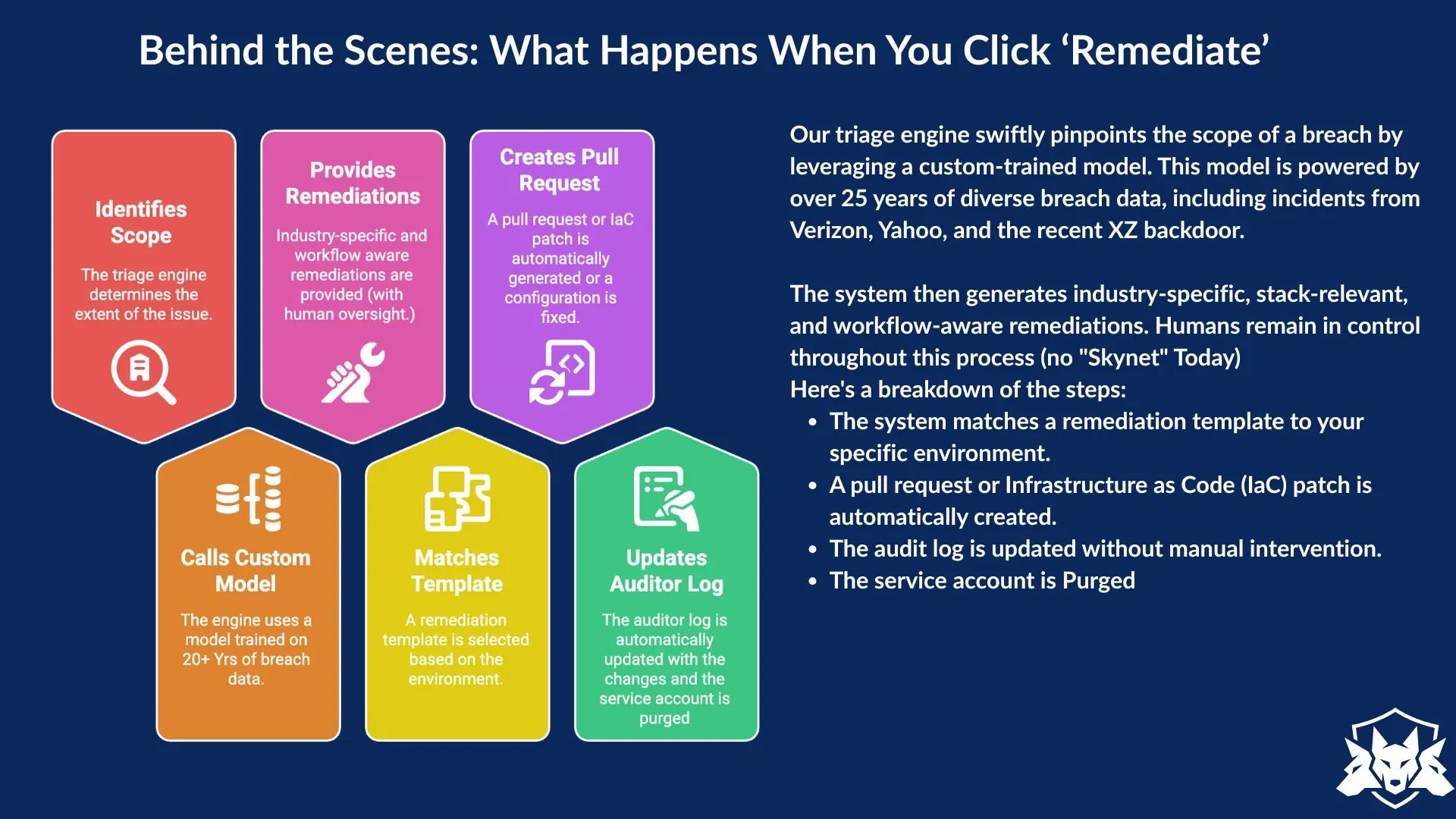
So what really happens when a user clicks that tempting “Remediate” button?
Behind the scenes, our Triage Engine kicks off the following chain of events:
- Identifies Scope - The extent of the failure is scoped.
- Calls Custom Model - Our ML model trained on over 25 years of global breach data (from Verizon, Yahoo, and even the recent XZ backdoor) is invoked.
- Provides Remediations - Context-aware fixes tailored to your tech stack and environment are suggested (and approved by humans).
- Creates Pull Request - Infrastructure-as-Code (IaC) patches or PRs are generated and staged for review.
- Matches Template - Control templates are dynamically mapped.
- Updates Auditor Log - All actions are recorded and linked to compliance policies.
The kicker?
All this happens within your environment, no agent, no forwarding, no guesswork. And access is purged automatically post-action.
Why Risk Remediation Within Your Environment Matters
- Reduces noise and backlog for Engineering teams
- Slashes MTTR from days to minutes
- Auto-closes security control gaps
- Keeps auditors, CISOs, and DevOps aligned
- Encourages proactive over reactive compliance
By turning remediation into an automated, observable, and safe-by-design loop, we’re reducing organisational risk without slowing down software teams.
Looking Ahead
Remed-AI is already live in early-stage customer environments, with new features rolling out every sprint. Here’s what’s next:
- Risk-aware prioritisation of control failures
- Explainable AI with remediation reasoning
- Self-learning controls that evolve with infrastructure changes
Remediation doesn’t have to be painful.
With Remed-AI, it’s a feature, not a firefight.
Request a demo to see how automated risk remediation can redefine and improve your vulnerability management lifecycle.